


Many people use “magnet” and “magnetism” as if they mean the same thing. But they don’t. They refer to two different concepts that are closely connected. Understanding what is the difference between magnet and magnetism is your first step toward grasping this area of physics. It will also help you make smart choices for any project.
The distinction is simple. A magnet is a physical object. Magnetism is an invisible force.
Picture a light bulb and the light it creates. You can hold the light bulb in your hand. But light itself? That’s the phenomenon the bulb produces. You can’t grab light, but you can see it and use what it does. It’s the same with magnets. The magnet is the object. Magnetism is the force it sends out.
Quick Answer:
A magnet and magnetism are different, but they’re linked forever. You can’t get the practical effects of magnetism without a source. That source is the magnet. This guide will explore both the object and the force in detail. You’ll get a clear, practical understanding of each.
Table of Contents
What is a Magnet?
A magnet is a material or object that produces a persistent external magnetic field. It’s the real, touchable source of the invisible force we call magnetism. You can touch it. You can measure it. You can put it to work.
Defining a Magnet
In simple terms, a magnet is a material where tiny components inside align in a specific way at the atomic level. This unified alignment lets their individual, tiny magnetic forces combine. Together, they project a larger, usable magnetic field outside the object itself.
Not all materials can become magnets. Whether a material can be magnetized depends on its atomic structure. We’ll explore this topic further.
Permanent vs. Temporary
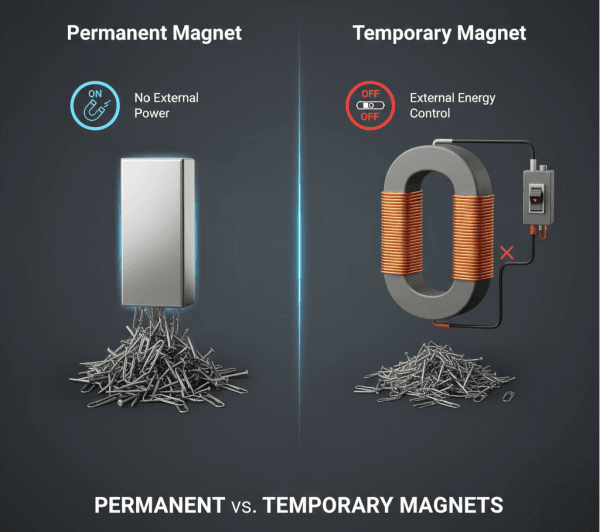
Magnets fall into two main families. The difference is based on how they keep their magnetic properties. This distinction matters for any practical use.
A permanent magnet keeps its magnetic properties without needing outside power or a magnetic field. The common refrigerator magnet is a perfect example. It stays magnetic on its own. These are made from “hard” magnetic materials. They’re difficult to magnetize but also difficult to demagnetize.
A temporary magnet only acts like a magnet when it’s inside a strong magnetic field. Or when electric current flows through it. Take a simple paperclip that sticks to a magnet. It becomes a temporary magnet itself. Remove the permanent magnet, and the paperclip loses most or all of its magnetism. Electromagnets are the most common type of powerful temporary magnet.
Feature | Permanent Magnet | Temporary Magnet |
Source of Magnetism | Internal atomic alignment | External magnetic field or electric current |
Retains Magnetism? | Yes, indefinitely (under normal conditions) | No, only when the external field is present |
Common Materials | Neodymium, Ferrite, SmCo, Alnico | Soft Iron, Steel Alloys |
Example | Fridge magnet, speaker magnet, compass needle | Electromagnet, paperclip stuck to a magnet |
Magnet Materials
The “secret sauce” of a magnet lies in what it’s made of. The most common materials that can be strongly magnetized are called ferromagnetic materials.
The main ferromagnetic elements are iron, nickel, and cobalt. For centuries, magnets were made mostly from these elements or their alloys, like Alnico (aluminum, nickel, cobalt).
Modern magnet technology has come a long way. This has led to powerful rare-earth magnets. These offer incredible performance in small sizes.
The main types of modern permanent magnets include:
- Neodymium magnets: Made from an alloy of neodymium, iron, and boron (NdFeB). These are the strongest commercially available permanent magnets. Their incredible strength-to-size ratio has changed industries from consumer electronics to electric vehicles.
- Ferrite (Ceramic) magnets: Made of iron oxide and strontium carbonate. These are the most widely used magnets because they cost little and resist corrosion and demagnetization well. They are the familiar gray or black magnets used in fridge magnets and basic DC motors.
- Samarium Cobalt (SmCo) magnets: The first commercially viable rare-earth magnets. SmCo magnets offer high strength and excellent performance at high temperatures where other magnets might fail.
North and South Poles
Every magnet has a key characteristic: it has two poles. A North pole and a South pole. This comes directly from how its magnetic field is structured.
These poles follow a simple, universal law. Opposite poles attract, and like poles repel. The North pole of one magnet will be strongly attracted to the South pole of another. But two North poles will push each other away.
Here’s an interesting fact about magnetism: you can never isolate a single pole. Cut a bar magnet in half, and you don’t get a separate North pole and a separate South pole. Instead, you get two new, smaller magnets. Each has its own North and South pole. This concept is called the non-existence of magnetic monopoles. It’s a fundamental principle of physics.
What is Magnetism?
If a magnet is the object, magnetism is the invisible force it creates. It is a fundamental phenomenon of nature. It’s responsible for everything from Earth’s protective shield to how MRI machines work.
To truly understand the difference between a magnet and magnetism, we must explore what this force is. We need to know where it comes from.
A Fundamental Force
Magnetism is one of the four fundamental forces of nature. The others are gravity, the strong nuclear force, and the weak nuclear force. It governs how electrically charged particles interact.
Importantly, magnetism is not a separate force. It’s one half of a single phenomenon called electromagnetism. A moving electric charge creates a magnetic field. A changing magnetic field creates an electric current. This deep connection is the foundation of modern technology. It powers electric motors, generators, and transformers.
Atomic Origins
Magnetism starts deep within atoms. Specifically, with a property of electrons called “spin.”
Think of each electron as a tiny, spinning ball of negative charge. This movement of charge generates a tiny magnetic field. This turns every electron into a nano-sized magnet with its own North and South pole.
In most materials, electrons exist in pairs that spin in opposite directions. Their magnetic fields cancel each other out. The result is no net magnetic effect. The material is non-magnetic.
But in ferromagnetic materials like iron, atoms have several unpaired electrons. Their spins can be influenced to align in the same direction.
Magnetic Domains
This alignment doesn’t happen across the entire material at once. Instead, it occurs in tiny regions called magnetic domains.
Imagine a stadium full of people. If everyone looks in a random direction, there’s no overall “direction” for the crowd. This is like an unmagnetized piece of iron. The magnetic domains are all randomly oriented. Their magnetic fields cancel each other out.
Now imagine a coach tells everyone to turn and watch the game on the field. The entire crowd now has a unified focus. This is what happens when a ferromagnetic material is magnetized. An external magnetic field is applied. This causes the magnetic domains to align in the same direction. When enough domains are aligned, their individual magnetic fields add up. They create a strong, large-scale magnetic field that extends outside the material. This is how an object becomes a magnet.
The Magnetic Field
We can’t see magnetism, but we can visualize its influence through the magnetic field concept. The magnetic field is the region of space around a magnet where its magnetic force can be detected.
Scientists and engineers use imaginary lines called magnetic field lines to map this field. These lines flow out of the North pole and loop around to enter the South pole.
The density of these lines shows the strength of the field. Where the lines are closest together—typically at the poles—the magnetic force is strongest. As you move farther from the magnet, the lines spread out. The force weakens.
Choosing the Right Magnet

At AQ Magnet, we’ve helped thousands of customers select the perfect magnet. From hobbyists to industrial engineers. Understanding magnetism principles is key to choosing the right magnet for your application. It’s not just about picking the biggest or shiniest one.
Here’s what we’ve learned are the most critical factors to consider. These are based on the properties of magnetism.
Key Magnetic Properties
When you select a magnet, you’re really selecting a set of magnetic properties suited for a specific task. Physical size is often secondary to these performance metrics.
- Strength (Magnetic Field Strength): This is the most common consideration. It measures the intensity of the magnetic field the magnet produces. This strength is measured in units like Gauss or Tesla (1 Tesla = 10,000 Gauss). While these units are crucial for engineers, a more practical measure for many users is “pull force.” This tells you how much weight a magnet can hold under ideal conditions.
- Temperature Resistance: Magnetism is highly sensitive to heat. Every permanent magnet has a maximum operating temperature and a Curie Temperature. If a magnet is heated above its Curie Temperature, thermal energy will cause its magnetic domains to become randomized. It will permanently lose its magnetism. This is critical for magnets used in motors, sensors, or any high-heat industrial application.
- Corrosion Resistance: Some of the most powerful magnets are also the most vulnerable to the environment. Neodymium magnets, for instance, rust very easily. They’re almost always sold with a protective coating (like nickel-copper-nickel) to prevent damage. Ferrite magnets, on the other hand, are essentially ceramics. They resist corrosion very well.
- Shape and Orientation: A magnet’s shape significantly affects the shape and direction of its magnetic field. A long, thin magnet will have a different field projection than a short, wide disc. The direction of magnetization (like axially through the thickness or diametrically across the diameter) is also a critical specification.
Matching Magnet to Job
With these properties in mind, you can start to match the right type of magnet to your specific application.
- For Maximum Strength in Small Spaces: The clear winner is N52 Neodymium Magnets. Their unmatched energy density makes them the default choice for applications where space and weight matter most. Examples include high-performance drone motors, miniature sensors, high-end audio speakers, and elegant magnetic clasps for jewelry and packaging.
- For Cost-Effective, General-Purpose Use: Ferrite (Ceramic) Magnets are the workhorses of the magnet world. While not as strong as neodymium, they’re inexpensive and highly resistant to corrosion. They perform reliably. They’re perfect for holding applications, refrigerator magnets, basic science experiments, and simple DC motors.
- For High-Heat Environments: When an application involves high temperatures, standard neodymium magnets will fail. Think sensors inside an engine block or components in aerospace systems. This is where Samarium Cobalt (SmCo) or Alnico magnets excel. They retain their magnetism at much higher temperatures. This ensures reliability in demanding conditions.
Beyond the Basics
The world of magnets and magnetism includes more than just basic attraction and repulsion. Understanding how to measure, control, and even destroy magnetism is essential for advanced applications. It’s also important for maintaining the longevity of your magnets.
Measuring Magnetism
How do we measure the invisible force of magnetism? Professionals use specialized tools and units to get precise measurements.
The most common scientific unit is Gauss (or Tesla). This measures magnetic flux density. Essentially, how concentrated the magnetic field lines are in a given area. A specialized instrument called a Gaussmeter or Teslameter with a Hall probe takes these readings at a specific point in space.
For many users, a more practical metric is Pull Force. This is not a scientific unit of magnetism itself. But it’s a real-world test of performance. It measures how much force is required to pull the magnet straight off a flat steel plate, typically in pounds or kilograms. This value gives a direct, understandable indication of a magnet’s holding power.
Demagnetization
A common question is: can a permanent magnet lose its power? The answer is yes. The carefully aligned magnetic domains in a permanent magnet can be knocked out of alignment. This process is called demagnetization.
There are several primary causes for this loss of magnetism:
- Heat: As discussed, this is the most common enemy of a magnet. Exceeding a magnet’s maximum operating temperature will cause a temporary loss of strength. Exceeding its Curie temperature will cause a permanent, irreversible loss.
- Repulsive Fields: Exposing a magnet to a strong, opposing magnetic field can forcibly re-orient its magnetic domains. This weakens or even reverses its polarity. This can happen if two strong magnets are slammed together in repulsion. Or if a permanent magnet is placed in a powerful electromagnet.
- Physical Shock: Severe impacts, like dropping a magnet on a hard surface, or intense vibrations can physically jostle the magnetic domains out of alignment. This effect is more pronounced in older magnetic materials like Alnico. It’s less so in modern neodymium or ferrite magnets, but it’s still a factor.
- Time: All permanent magnets will naturally lose a very small fraction of their strength over time. For modern materials like neodymium, this loss is negligible. Often less than 1% over a decade.
A practical tip for storage: keep your magnets away from high-heat sources and powerful electronic devices that generate their own fields. Handle them with care to avoid sharp impacts.
An Inseparable Pair
We return to our core question: what is the difference between a magnet and magnetism? In the simplest terms, a magnet is the source. Magnetism is the power it projects. The magnet is the object. Magnetism is the fundamental force.
It’s the partnership between the light bulb and the light. One is a real object defined by its material and structure. The other is an invisible but powerful phenomenon that shapes our world.
This distinction is more than just a word exercise. Understanding it lets us move from simply watching a curious effect to harnessing a fundamental force of the universe. It’s the knowledge that enables an engineer to design a more efficient motor. It helps a scientist build a more powerful particle accelerator. It allows a hobbyist to choose the perfect product for their creation.
Ultimately, the magnet and magnetism exist in perfect harmony. The unique atomic structure of the magnet gives rise to the force of magnetism. And it’s the force of magnetism that gives the magnet its purpose and power. One cannot exist in any practical sense without the other.
Facebook
Twitter
LinkedIn