
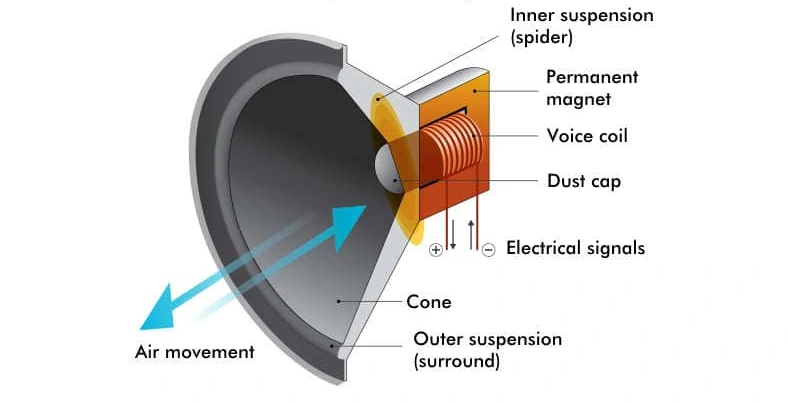

Speakers rely on a permanent magnet to create a stable, powerful magnetic field. An electrical audio signal from an amplifier flows into a wire coil called the voice coil. This turns it into a temporary electromagnet.
The core principle is magnetic interaction. The voice coil’s fluctuating magnetic field gets rapidly attracted to and repelled by the permanent magnet’s static field.
This creates rapid push-pull motion. It forces the voice coil and attached speaker cone to vibrate back and forth thousands of times per second. This physical movement pushes and pulls air, creating pressure waves. Our ears interpret these waves as sound. The magnet serves as the silent, stationary anchor that makes this entire conversion from electricity to motion possible.
In this guide, we will break down this entire process. We’ll examine the science behind the speaker motor and compare the critical differences between magnet types. We’ll also explain what this all means for you. Whether you’re buying new headphones, building a DIY speaker, or sourcing magnetic components for manufacturing, this is your complete resource.
Table of Contents
Principle: Electricity to Sound

At its heart, a dynamic speaker operates on a fundamental law of physics. This principle explains the direct relationship between electricity and magnetism.
When electrical current travels through a wire placed within a magnetic field, a physical force acts on that wire. This is the engine of the speaker. You can learn more about the fundamental principles of electromagnetism to understand the deep science.
Think of the simple interaction between two bar magnets. Like poles (north-north) repel. Opposite poles (north-south) attract. Now imagine one of those magnets is the speaker’s permanent magnet, which is fixed and unchanging.
The other magnet is the voice coil. It becomes an electromagnet only when the audio signal flows through it. The music’s electrical signal is alternating current. This means its direction and intensity constantly change.
This causes the voice coil’s magnetic polarity (its north and south poles) and magnetic strength to flip and fluctuate in perfect sync with the music. It becomes a dynamic, agile magnet dancing with its stationary partner.
This process breaks down into five clear steps:
- The Audio Signal: An amplifier sends a fluctuating electrical current to the speaker. This current is a precise electronic copy of the sound wave.
- The Electromagnet: This current flows into the voice coil. The coil instantly generates its own magnetic field. The polarity and strength mirror the audio signal at that exact moment.
- The Interaction: The voice coil’s rapidly changing magnetic field interacts with the permanent magnet’s constant, powerful field. This creates forces of attraction and repulsion.
- The Motion: The permanent magnet is fixed in the speaker’s heavy frame. The lightweight voice coil is the part that moves. It gets rapidly pushed and pulled in and out of the magnetic gap.
- The Sound: The speaker cone attaches directly to the voice coil. As the coil moves, the cone moves with it, vibrating like a drum skin. This vibration displaces air, creating the pressure waves we perceive as sound.
Anatomy of a Speaker Driver

To truly understand speaker magnet function, we must look at the entire system it operates within. This system is often called the speaker driver’s “motor structure.” It’s a precisely engineered assembly where every part has a critical role.
A labeled cross-section diagram of a dynamic speaker driver would be ideal here to visualize how these components fit together. The magnet is the foundation. But its power is useless without the other players.
The Permanent Magnet
The permanent magnet is the unwavering foundation of the speaker motor. Its sole purpose is to generate a strong, static, and perfectly symmetrical magnetic field. This field exists within a very narrow circular channel known as the magnetic gap.
This magnet, along with a steel top plate and central pole piece, forms the complete magnet assembly. This structure is heavy and rigid. It’s designed to focus the magnetic flux directly where the voice coil sits. It is the static, unchanging part of the equation. It provides the constant force against which the voice coil works.
We can think of it as the engine block. It provides the structure and raw potential energy for the system, waiting for the dynamic parts to act upon it. The design of this assembly is critical for the speaker’s efficiency and linearity.
The Voice Coil
The voice coil is the agile engine of the speaker. It’s a deceptively simple component. A length of very fine wire, typically copper or aluminum, precisely wound around a lightweight, cylindrical tube called a former.
Its function is to transform into an electromagnet the instant an audio signal passes through it. The electrical current’s direction determines the coil’s magnetic polarity (which end is north and which is south). The current’s amplitude, or power, determines its magnetic field strength.
To accurately reproduce sound, the voice coil must be incredibly responsive. It must be light enough to accelerate and change direction thousands of times per second without inertia smearing the sound. This is why materials and winding techniques are so critical to its design. It is the direct link between the amplifier’s electrical world and the mechanical world of sound.
The Diaphragm or Cone
The diaphragm is the most visible part of a speaker. It’s often called the cone or, in tweeters, the dome. The voice coil former bonds directly to the base of this diaphragm.
Its job is simple in concept but complex in execution. It must move in perfect synchrony with the voice coil’s motion. As magnetic forces push and pull the voice coil, it drives the cone with it.
This large surface area allows it to effectively push and pull the surrounding air. This creates the sound waves that travel to our ears. The diaphragm’s material has a profound impact on the final sound signature. Whether it’s treated paper, polypropylene, aluminum, beryllium, or silk affects its stiffness, damping, and weight.
The Suspension System
Two other components are essential for controlled motion: the spider and the surround. Together, they form the speaker’s suspension system.
The surround is the flexible ring at the cone’s outer edge. It connects the cone to the speaker’s frame or basket. It allows the cone to move in and out freely over a specific distance (its excursion).
The spider is a corrugated, fabric-like disc that sits behind the cone. Its primary job is to hold the voice coil perfectly centered within the narrow magnetic gap. Without the spider, the coil would easily crash into the sides of the magnet assembly. It acts as the rear suspension point, ensuring the coil only moves along its intended axis.
Neodymium vs. Ferrite Magnets

When discussing magnets in a speaker, the conversation inevitably turns to the two dominant materials. Neodymium is the modern high-performer. Ferrite is the traditional workhorse. The choice between them is one of the most significant design decisions an engineer makes.
Neodymium magnets (NdFeB) are part of the rare-earth magnet family. They are the strongest type of permanent magnet commercially available. Ferrite magnets, also known as ceramic magnets, are made from strontium carbonate and iron oxide. This makes them much more common and less expensive.
Their properties dictate their use cases. They affect everything from performance and size to cost and durability. We often see expert audio engineers often debate the merits of each material. Neither is universally “better.” The choice is always about the specific application and design goal.
For a clear comparison, we can break down their key differences in a table.
Feature | Neodymium Magnets | Ferrite (Ceramic) Magnets |
Magnetic Strength (BHmax) | Very High (up to 52 MGOe) | Moderate (up to 4.5 MGOe) |
Size & Weight | Small and lightweight for the same magnetic force | Bulky and heavy for the same magnetic force |
Cost | Significantly Higher | Very Cost-Effective |
Temperature Resistance | Lower; can lose magnetism at high temps (~80-200°C) | Excellent; stable at high temps (up to 250°C) |
Corrosion Resistance | Poor; requires protective coating (e.g., Ni-Cu-Ni) | Excellent; highly resistant to corrosion |
Common Applications | High-end headphones, portable speakers, pro audio, slim drivers | Home audio, car speakers, woofers, budget-friendly designs |
The most dramatic difference is strength-to-size. A neodymium magnet can generate the same magnetic field strength (flux) as a ferrite magnet many times its size and weight. This is a game-changer for applications where space and weight are critical. Think in-ear monitors, headphones, and portable Bluetooth speakers.
However, this performance comes at a price. Neodymium is a rare-earth element. Its price can be volatile and significantly higher than ferrite. This makes cost-effective ferrite magnets the default choice for many applications. This is especially true for large drivers like woofers or budget-conscious designs where a larger, heavier motor is acceptable.
Temperature is another key factor. Standard neodymium magnets can begin to lose their permanent magnetism (demagnetize) at relatively low temperatures, sometimes as low as 80°C. While high-temperature grades exist, they come at an even greater cost. Ferrite is naturally much more stable at high temperatures. This makes it a robust choice for high-power applications like professional audio subwoofers where voice coils can get very hot.
This is why you see powerful but compact high-strength neodymium magnets used in premium headphones. They allow for potent sound from a tiny driver. Conversely, you’ll find massive, heavy ferrite magnet structures on the back of classic 15-inch woofers. In those applications, size is less of a concern than raw power handling and cost.
Does a Better Magnet Mean Better Sound?
This is a critical question and a source of common misconceptions. The simple answer is no. A “better” or stronger magnet, in isolation, does not guarantee better sound quality. The speaker’s performance is a product of holistic design and engineering synergy.
In our experience engineering magnetic assemblies for audio clients, we often see a tendency to focus on a single specification. However, the magnet is just one part of a complex electromechanical system. A powerful engine in a car with a poor transmission and bad tires will not perform well. The same is true for speakers.
Myth: Bigger is Better
A common assumption is that a larger magnet is always a better magnet. This is not necessarily true. The ultimate goal is not maximum brute force. It’s creating a highly focused and symmetrical magnetic field within the precise area where the voice coil travels—the magnetic gap.
The measure of this is flux density, measured in Tesla (T) or Gauss. A well-engineered, smaller magnet assembly that efficiently focuses its energy into the gap can produce higher flux density and better performance than a large, poorly designed magnet. A poorly designed magnet “leaks” much of its magnetic field. It is a matter of precision engineering, not just raw size.
Myth: Neodymium is Always Better
Because neodymium magnets are stronger and more expensive, many assume they always result in a superior-sounding speaker. This is a marketing oversimplification.
Neodymium’s high strength-to-weight ratio is an undeniable advantage. It allows for the design of smaller, lighter, and often more efficient drivers. This is fantastic for headphones, where weight is paramount. It’s also great for professional line-array speakers, where dozens of drivers must be hung in the air.
However, some of the most legendary and beloved hi-fi speakers ever produced use massive, exceptionally well-engineered ferrite motor systems. Many audio engineers and enthusiasts chase the specific sonic character of classic ferrite woofers. This character is often described as “warm,” “punchy,” or “natural.” The choice of magnet material is a tool used to achieve a specific design goal and target sound. It’s not a simple indicator of quality.
What Truly Matters: Engineering
The ultimate sound quality of a speaker comes from the synergy between all its components. The engineer must balance the magnet’s properties with the voice coil’s mass and inductance, the cone’s material and geometry, the suspension’s compliance, and the enclosure’s volume and tuning.
A skilled designer uses the specific characteristics of a magnet type as a cornerstone of their design. They might choose ferrite for its thermal stability and cost-effectiveness in a high-power subwoofer. Or they might choose neodymium to create a highly sensitive tweeter with exceptional detail. It is all part of the holistic art of speaker engineering.
A Practical Guide for Users
Understanding how speakers use magnets is one thing. Applying that knowledge is another. Here is a practical guide tailored to different types of users, from consumers to professional engineers.
For the Consumer
When you’re shopping for speakers or headphones and see “Neodymium Drivers” listed as a feature, you now know what it implies. It typically signals a design that prioritizes efficiency (gets loud with less power), a lightweight build, and/or a slim profile.
This is often a positive feature, especially in portable audio. However, don’t assume it automatically means “better sound.” A well-executed speaker using ferrite magnets can easily outperform a poorly designed one using neodymium.
The most important tool you have is your ears. Don’t judge a speaker by its spec sheet or magnet type alone. Listen to it. If possible, compare it to other models. The final sound is what matters, not the individual ingredients.
For the DIY Hobbyist
For those building their own speakers, the choice of driver and its magnet is a fundamental decision. Your project’s goals will guide your choice. Are you building a compact, portable Bluetooth speaker? A lightweight neodymium driver is the ideal choice to maximize performance and battery life.
Are you building a classic 12-inch guitar cabinet or a powerful home theater subwoofer? A traditional driver with a large ferrite magnet is an excellent and cost-effective option that can deliver fantastic results.
A common mistake for beginners is focusing only on magnet size. In our experience, it’s far more crucial to understand the driver’s Thiele/Small (T/S) parameters. These specifications, including the motor strength factor (Bl), tell you how the driver will perform and what kind of enclosure it needs. A strong magnet (high Bl) contributes to a more efficient and controlled driver. But it must be matched with the other parameters for the project to succeed. You can find many valuable resources for your next build on dedicated forums.
For the Professional
For purchasing agents and design engineers, the conversation moves beyond simply “neodymium vs. ferrite.” When sourcing speaker magnets or complete drivers, you must specify a host of critical magnetic properties.
This includes the specific grade of the material (e.g., N42, N52 for neodymium; Y30, Y35 for ferrite), which defines its magnetic strength (BHmax). You must also consider its intrinsic coercivity (Hcj) for temperature stability and its overall temperature coefficient.
For mass production, consistency is arguably more important than a single “hero” specification on a datasheet. A driver’s performance depends on the magnet’s flux being the same from the first unit to the ten-thousandth. This is why partnering with a supplier who can guarantee tight tolerances and batch-to-batch consistency is paramount. When sourcing high-quality magnetic solutions, robust quality control and a reliable supply chain are non-negotiable.
Always ensure your supplier adheres to recognized industry standards for magnetic materials. This provides a baseline for quality and performance comparison.
Facebook
Twitter
LinkedIn
WhatsApp